Neovarsity Launches Advanced Course in Lithium-ion Battery Safety and Abuse Modeling
Learn to model, predict, and prevent lithium-ion battery failures in our advanced course with Dr. Samuel Ogunfuye and build safer, smarter energy systems.
3 min read
June 12th, 2025
Last updated: June 13th, 2025

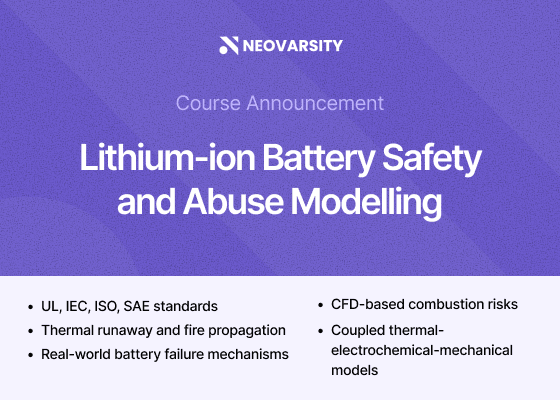
From Battery Incidents to Engineering Solutions
Lithium-ion batteries have become indispensable across EVs, grid storage, and portable electronics. The growing intensity of their use has magnified one of their most pressing risks: safety failures.
From thermal runaway to fire propagation, safety incidents not only damage products but can also endanger lives.
We’re launching this new course to equip engineers and researchers with the modeling expertise to anticipate and mitigate such failures before they happen.
Lithium-ion battery safety and abuse modelling is an 8-week advanced blended program designed to give you practical and rigorous training in abuse modeling, multiphysics simulation, and design interventions for safety-critical battery systems.
Why Safety and Abuse Modelling Matters
Battery failure isn’t just a defect. It’s often a cascade.
A localized event like overcharging or mechanical puncture can escalate into thermal runaway, fire, and even explosions. For engineers, waiting for field data or relying on trial-and-error lab testing is no longer enough.
You need virtual tools and simulation workflows that can:
Predict abuse responses such as heating, gas generation, venting
Model multi-scale propagation across cells, modules, and packs
Evaluate mitigation strategies through computational analysis
And above all, help you meet stringent global safety standards before your designs hit the market.
Working on battery recalls? Predict failure triggers before they leave the factory floor.
Enroll now for this Expert-led Battery Safety Course. Limited seats only!
What You’ll Learn
This course covers the full lifecycle of battery safety modeling from core science to compliance-ready simulations.
Across the eight modules, you will:
Dissect real-world battery failure mechanisms and their root causes
Build and validate coupled thermal-electrochemical-mechanical models for abuse scenarios
Simulate thermal runaway and fire propagation at the cell-to-pack scale
Analyze CFD-based combustion risks and explore passive/active mitigation strategies
Navigate UL, IEC, ISO, SAE standards and construct certification workflows
You’ll also gain hands-on experience with abuse modeling tools, work with a curated test data bank, and design mitigation systems for EVs and BESS.
Who Is This Course For
This is not a lecture-heavy course. It is an industry-relevant hands-on course designed for engineers and applied researchers who want to simulate and build better, safer batteries.
| Level | Advanced |
| Mode | Blended (Live + Self-paced) |
| Duration | 8 weeks |
| Category | Energy Technology |
Whether you're working on vehicle thermal systems, battery pack architecture, or regulatory approval, this course gives you frameworks you can immediately apply.
Learn from an Industry Leader
You’ll be mentored by Dr. Samuel Ogunfuye, a seasoned mechanical engineer with a Ph.D. from West Virginia University. Currently a Senior Mechanical Engineer at Johnson Controls, Dr. Ogunfuye previously held a pivotal role in battery R&D at Caterpillar Inc., where he specialized in high-fidelity modeling and simulation for complex thermal-fluid systems.
His expertise spans CFD, computational multiphysics, battery safety, and data-driven engineering solutions with deep experience in coupling theoretical principles to real-world battery designs.
What sets him apart is his dual strength: deep industry experience and a rare talent for teaching advanced technical concepts in an approachable, application-focused way.
Under his guidance, you won’t just learn to model. You’ll learn to think like a systems engineer, simulate with purpose, and build with safety at the core.
Capstone Project to Cement Your Learning
In the final weeks of the course, you’ll work in a small team to complete a capstone project that brings together everything you’ve learned. Each team will analyze a safety-critical case, simulate abuse and failure scenarios, and design mitigation strategies based on thermal, electrochemical, and mechanical considerations. The project culminates in a group presentation where you’ll walk through your simulation workflow and design decisions, followed by detailed feedback from both your instructor and peers. It’s an opportunity to apply your skills to real-world challenges and build a portfolio-worthy artifact that showcases your modeling and engineering expertise.
Applications Are Open Now
The next cohort begins on June 22 and space is limited.
👉 Explore the curriculum and apply here
🔬 Questions? Contact Catherine at [email protected].
Let’s build batteries that last, and are safe!
Neovarsity is a Berlin-based deep tech skills platform. We build industry-driven, cohort-based programs in collaboration with world-class experts to prepare talent and teams to solve problems in areas with real-world impact.
Stay tuned for more updates and insights. Follow us on LinkedIn and join the conversation using #FutureThroughDeepTech.
Learn battery safety from an R&D expert at Johnson Controls
Don’t wait for the next incident. Engineer solutions that work under stress.
- Model thermal runaway, fire propagation, and abuse conditions
- Explore active and passive mitigation design with real test data
- Gain certification-ready skills with global standards like UL and IEC