A Capstone Project to Kickstart Your Hybrid Battery Modeling Skills
Explore how this Neovarsity capstone equips professionals to model battery aging by integrating physics-based simulations with data-driven machine learning approaches.
4 min read
July 9th, 2025
Last updated: July 9th, 2025


Introduction
Neovarsity's capstone projects are meticulously designed to bridge the gap between theoretical knowledge and real-world application, catering specifically to professionals in fields like AI-driven drug discovery, battery engineering, and molecular machine learning.
These projects are not mere academic exercises. They are comprehensive, hands-on experiences that mirror the complexities and challenges of industry scenarios. One of our many alumni testimonials comes from Sahil Gahlawat, who shares:
“The hands-on projects and theoretical knowledge have been instrumental in bridging the gap (between academic research and real-world industry problems), making my work more relevant and impactful in the industry.”
What We Build in Battery Modelling with ML Capstone
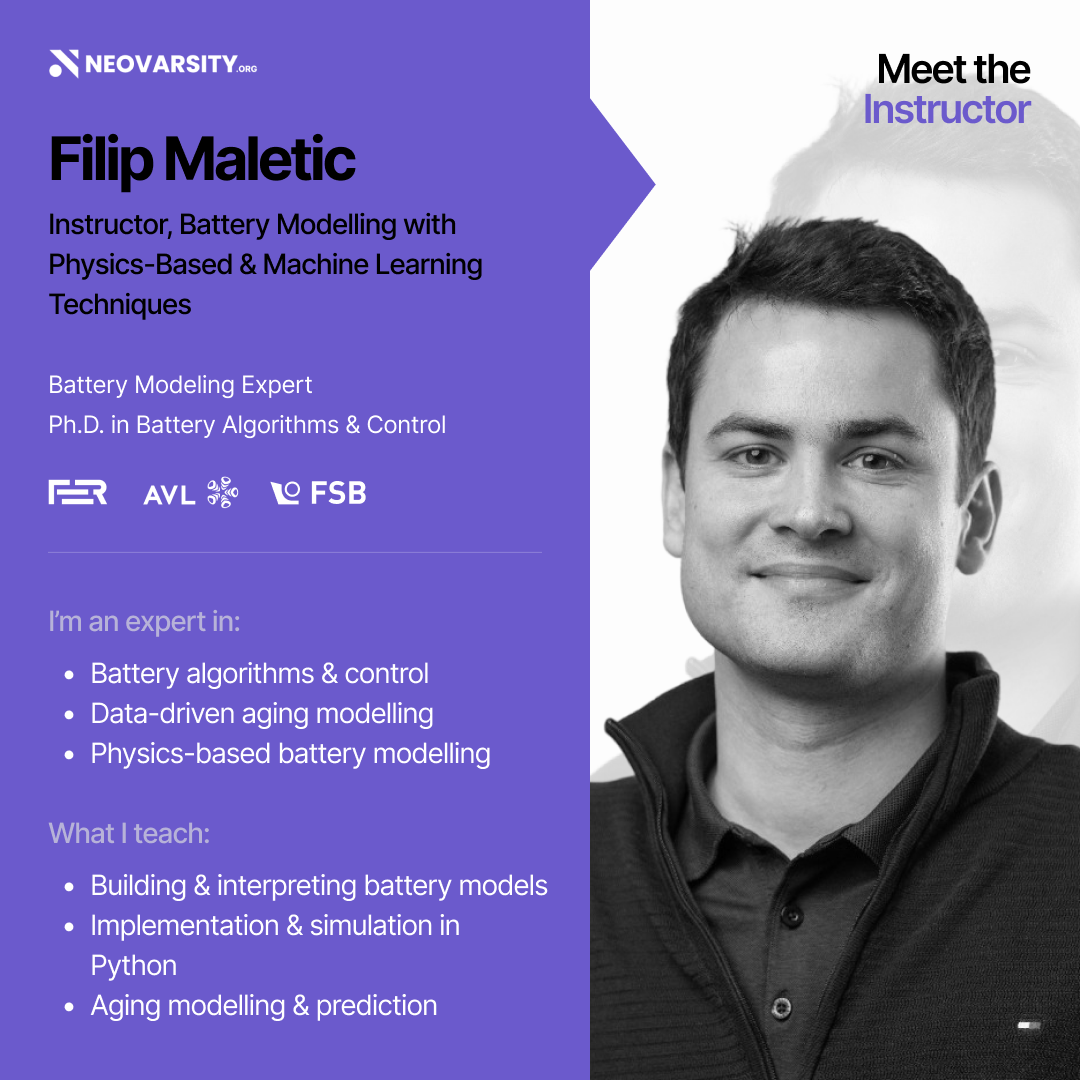
The capstone project in the course Battery modelling with physics-based and ML techniques, is led by Dr. Filip Maletic, an industry expert in electrochemical battery modeling.
The project offers an integrated experience that aligns closely with the methodologies used in applied R&D and product development teams. The battery capstone is about understanding and unifying three core aspects.
Physics-based battery models
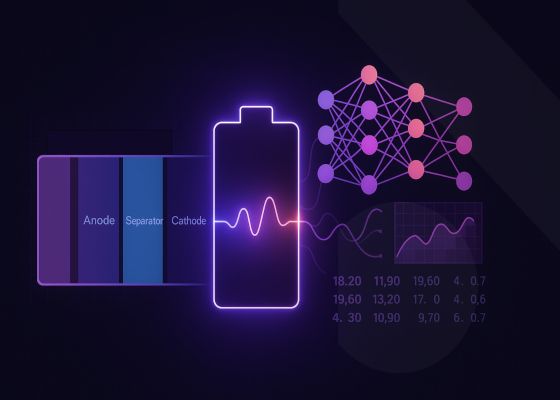
We begin by implementing first-principles differential-equation-based models that simulate electrochemical processes: charge/discharge cycles, thermal dynamics, and state evolution. These models form the backbone of physics-grounded insight into battery behavior.
Physics-based aging models
Next, we extend these simulations to incorporate degradation mechanisms. This includes capacity fade, impedance growth, and structural damage, i.e., modes of failure that emerge from electrochemical and mechanical stressors over time.
Data-driven aging models
Finally, we turn to statistical learning. Without relying on embedded physics, we construct empirical models directly from aging datasets. These methods are especially valuable in data-rich contexts where traditional simulations become computationally prohibitive or underconstrained.
We guide learners through these phases sequentially, culminating in hybrid modeling strategies that integrate physics-based and ML-based reasoning. This allows for more robust system-level predictions and practical deployment readiness.
Explore the battery modeling course here!
Modular Project Architecture
The capstone is not rigid. It is designed as a modular sequence with flexibility to match each learner’s background and career direction:
Part 1: Simulate aging with physics-based models
Using real or synthetic load profiles (e.g., EV drive cycles), we simulate degradation scenarios that industrial teams use to test design hypotheses before committing to expensive physical prototyping.
Part 2: Train ML models on simulated aging data
We extract features from simulation outputs and build machine learning pipelines to predict battery life or failure modes thereby reducing the need to solve complex PDEs repeatedly and allowing for rapid scenario evaluation.
Part 3 (Optional): Model with proprietary data
For those with ready access to in-house or field data, we support skipping simulation entirely. Instead, the focus shifts to feature engineering, interpretability, and model deployment using real-world datasets.
This modularity ensures the capstone remains relevant from early-career professionals building foundational fluency to seasoned practitioners refining applied hybrid models.
Practitioner Guidance from Industry
In contrast to industry environments where modeling often revolves around parameter calibration via detailed lab experiments, this capstone gives us the space to design and test model structures ourselves.
Dr. Filip Maletic brings an insider’s view to modeling workflows.
“ Physics-based models are powerful but demanding. They require extensive parameterization, typically done through electrochemical teardown studies. In this capstone, we use published values so that learners can focus on model formulation and interpretation.”
- Filip
This shift encourages a transition from measurement-dominant practices to model-centric innovation.
Translating to Industry Use-Cases
The capstone’s architecture directly supports high-value use cases found in energy and mobility sectors.
Simulated data expansion
In low-data regimes, we simulate high-resolution degradation trajectories to enrich training datasets, a well-known tactic in ML for physical systems.
Data feature engineering at scale
When rich telemetry is available, we teach structured approaches to isolate predictive features.This is critical for health forecasting, digital twins, and fleet-level analytics.
Iterative peer review
While not a replica of industrial code review, our peer-driven critique loop fosters the analytical rigor and iterative mindset essential in collaborative R&D settings.
“ It’s not how we reviewed models in the lab, but it’s a practical analogue. It teaches critical thinking and iterative improvement. The skills that absolutely translate to real-world modeling teams.”
- Filip
Deliverables with Depth
What we build in the capstone goes far beyond a finished project. It’s a full-spectrum demonstration of modeling fluency. By the end, you’ll be confident in:
Integrated use of simulation and machine learning
Robust handling of uncertainty and data noise
Strategic trade-offs between model transparency and predictive accuracy
Application to practical systems like EVs, stationary storage, or wear-level analysis
The capstone prepares professionals to converse fluently across electrochemistry, software modeling, and systems integration, making them indispensable contributors in interdisciplinary teams.
Final Perspective
For professionals looking to deepen their modeling expertise and bring advanced research into product contexts, our capstones are not stepping stones, they are accelerators. They align advanced learning with the decision-making and tooling found in high-impact technical teams. By offering a rigorous, practitioner-guided, and modular experience, we help learners transition not just into better roles, but into transformative contributors in deep-tech innovation.
Check out the course announcement here!
For questions, contact Catherine at [email protected].
And if you know someone working in batteries, energy, or applied ML, pass this along!
The battery industry needs more hybrid thinkers.
Neovarsity is a Berlin-based deep tech skills platform. We build industry-driven, cohort-based programs in collaboration with world-class experts to prepare talent and teams to solve problems in areas with real-world impact.
Stay tuned for more updates and insights.
Follow us on LinkedIn and join the conversation using #FutureThroughDeepTech.
Looking to upskill for high-impact roles in battery modelling?
This course teaches you how to model batteries using physics-based simulations and machine learning. You will gain:
- Fluency in Python-based battery simulation and ML integration
- Tools to accelerate your workflow and modeling accuracy
- Portfolio-ready outputs, including simulation plots and ML performance reports