Announcing Our New Course: Battery Modeling with Physics-based and Machine Learning Techniques
This course is designed for engineering and R&D teams working at the intersection of battery systems, machine learning, and simulation.
4 min read
June 6th, 2025
Last updated: June 11th, 2025

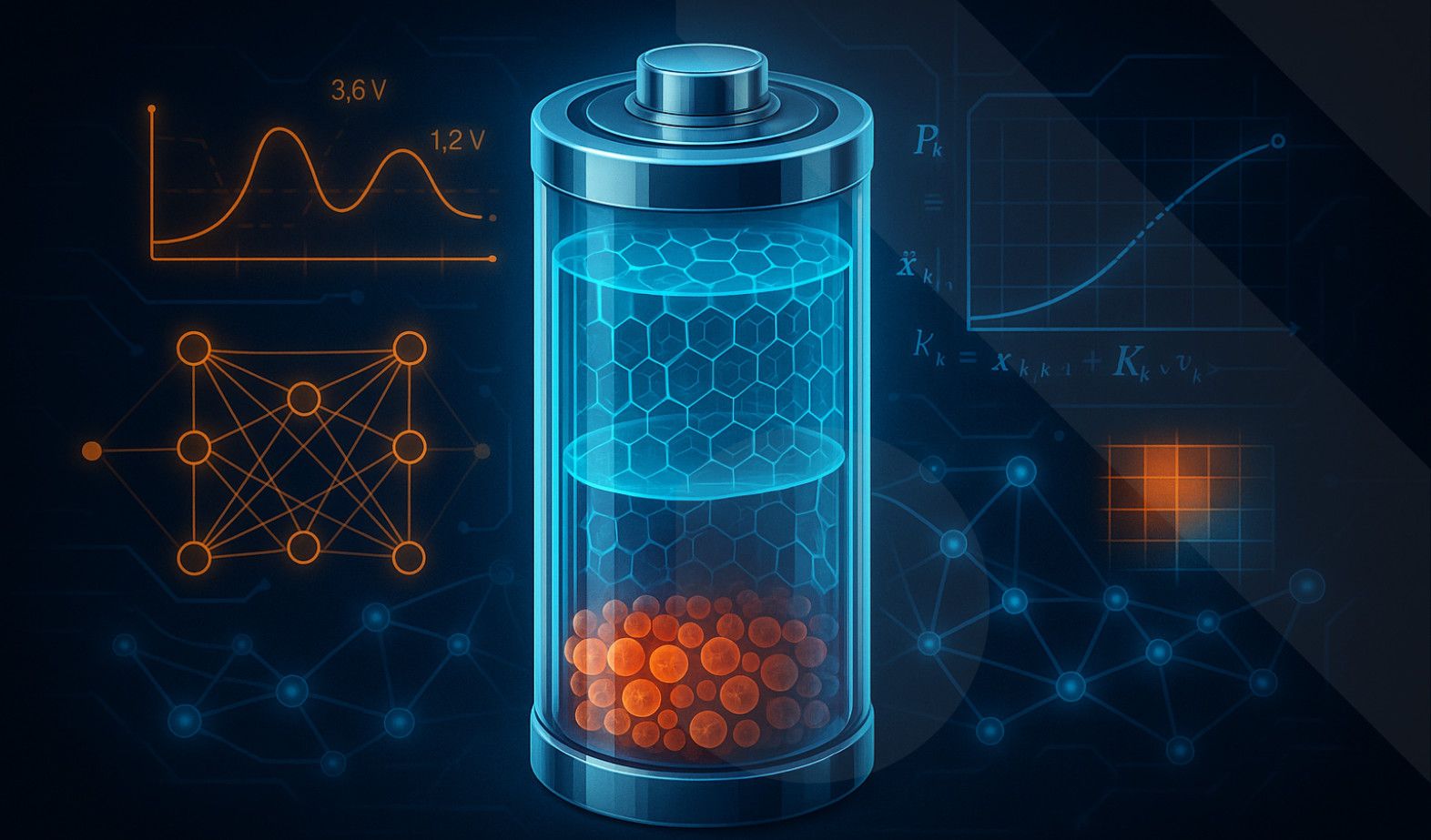
As the global demand for electrification and energy storage accelerates, the limitations of traditional battery modeling workflows have become painfully clear.
R&D teams are bogged down by slow simulations and labor-intensive experimentation.
Machine learning engineers are eager to contribute to energy and climate tech but often lack the domain knowledge to make meaningful impact. Meanwhile, original equipment manufacturers (OEMs) and grid-scale analysts face unpredictable battery behavior under real-world conditions, and the tools to model these systems just aren't keeping up.
It’s time to rethink how we simulate, predict, and optimize battery performance.
That’s why we’re excited to announce Battery Modeling with Physics-Based and Machine Learning Techniques course, a 6-week expert-led course built to equip engineers, scientists, and technical founders with the skills to build scalable, accurate, and reproducible battery models.
Why THIS Course?
This is not just another online course.
It’s a hands-on, industry-informed program that bridges the gap between physical modeling and data-driven insights. Designed with industry requirements in mind, the course blends the rigor of electrochemical simulation with the flexibility of machine learning.
Using tools like PyBaMM, Python, and TensorFlow, you’ll learn to model batteries across multiple scales, from microscale to pseudo-2D, and integrate thermal, aging, and impedance behaviors into your simulations. Then, you'll take it further: exporting synthetic data, training ML models to predict degradation, and building your own hybrid modeling pipeline in a capstone project.
Who Is THIS Course For?
This course was built for those pushing the boundaries of energy technology.
If you are:
A battery R&D engineer trying to accelerate your workflow and reduce reliance on time-consuming lab experiments,
A machine learning engineer transitioning from big tech or fintech into energy and materials modeling,
An automotive or BMS specialist working on battery state estimation, lifecycle prediction, or thermal management,
A grid-scale energy analyst trying to make sense of dynamic storage behavior under fluctuating demand,
A PhD student, postdoc, or industrial researcher seeking reproducible, publication-quality modeling pipelines, or,
A startup founder or consultant aiming to prototype high-fidelity models that actually work in the real world
then this course is designed for you.
More About The Course
Throughout the six weeks, you’ll dive into physics-based approaches like equivalent circuit modeling and pseudo-2D simulations, while also getting practical experience with ML frameworks tailored for battery systems.
You’ll compare modeling strategies, fine-tune thermal parameters, and use physics-informed neural networks (PINNs) to fuse domain knowledge with data. And because we know how important applied work is in this space, your final capstone will not only demonstrate your learning but serve as a showcase-worthy project for your portfolio, pitch deck, or product roadmap.
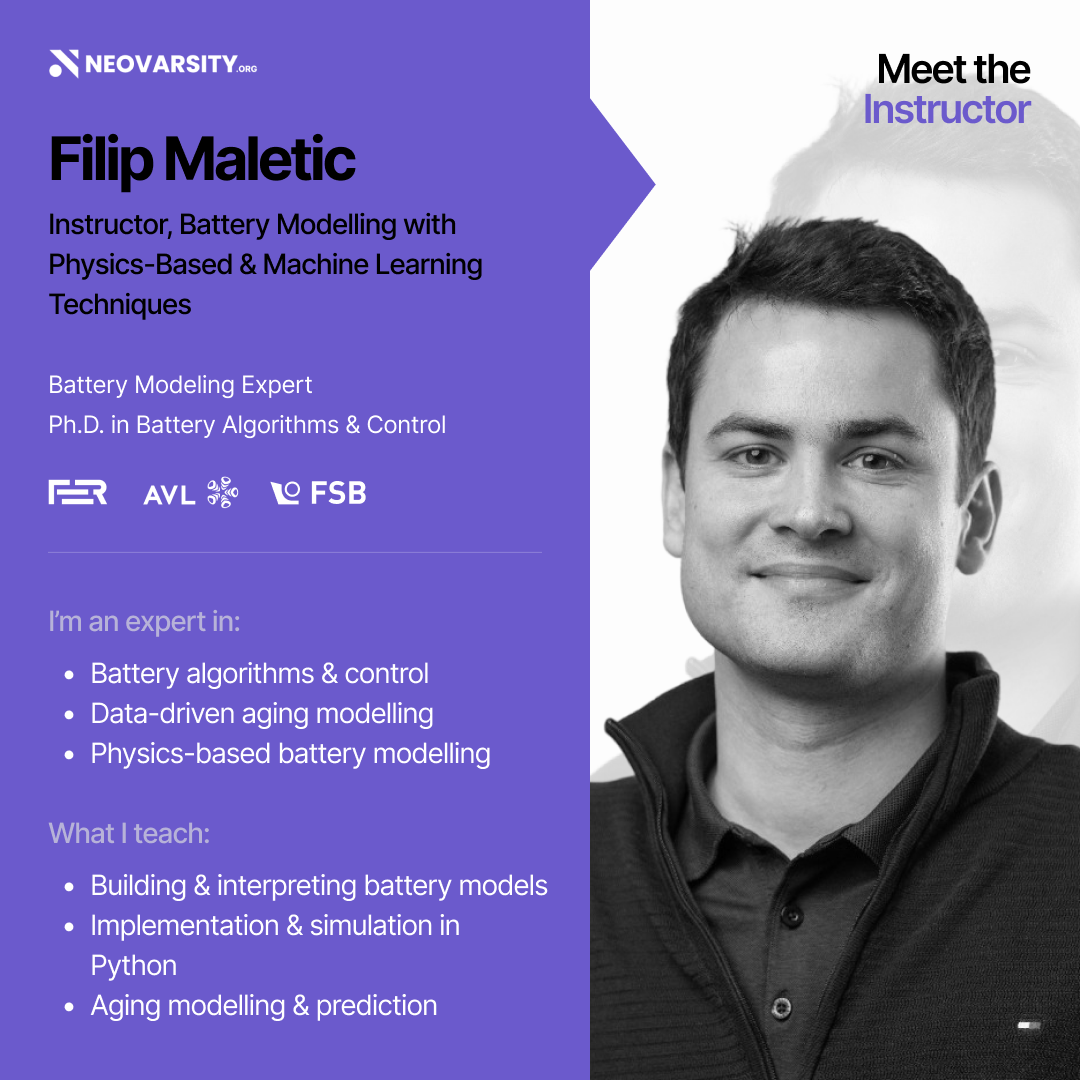
The course is led by Dr. Filip Maletic, a battery modeling expert with a Ph.D. in battery algorithms and control. His work spans advanced electrochemical modeling, Kalman filter-based state estimation, and data-driven aging models. Until recently at AVL List GmbH, one of the world’s largest automotive consultancies where he developed custom multiphysics models ranging from 3D microscale to full cell-level frameworks, bridging complex electrochemical behavior with real-world predictive performance.
This hands-on course is more than an educational experience.
It's an upgrade to your technical workflow, your modeling mindset, and your professional toolkit. Whether you're building next-gen BMS, modeling battery packs for renewable integration, or breaking into the energy AI space, you'll leave this course ready to deploy smarter, faster, more accurate simulations.
Battery modeling doesn’t need to be slow, siloed, or outdated anymore. With the right tools and instruction, it can be fast, integrated, and impactful.
Applications are open now
The next cohort begins on June 16 and space is limited. 👉 Explore the curriculum and apply here
For questions, contact Catherine at [email protected].
And if you know someone working in batteries, energy, or applied ML, pass this along! The battery industry needs more hybrid thinkers.
—
Neovarsity is a Berlin-based deep tech skills platform. We build industry-driven, cohort-based programs in collaboration with world-class experts to prepare talent and teams to solve problems in areas with real-world impact.
Stay tuned for more updates and insights. Follow us on LinkedIn and join the conversation using #FutureThroughDeepTech.
Looking to upskill for high-impact roles in battery modelling?
This course teaches you how to model batteries using physics-based simulations and machine learning. You will gain:
- Fluency in Python-based battery simulation and ML integration
- Tools to accelerate your workflow and modeling accuracy
- Portfolio-ready outputs, including simulation plots and ML performance reports